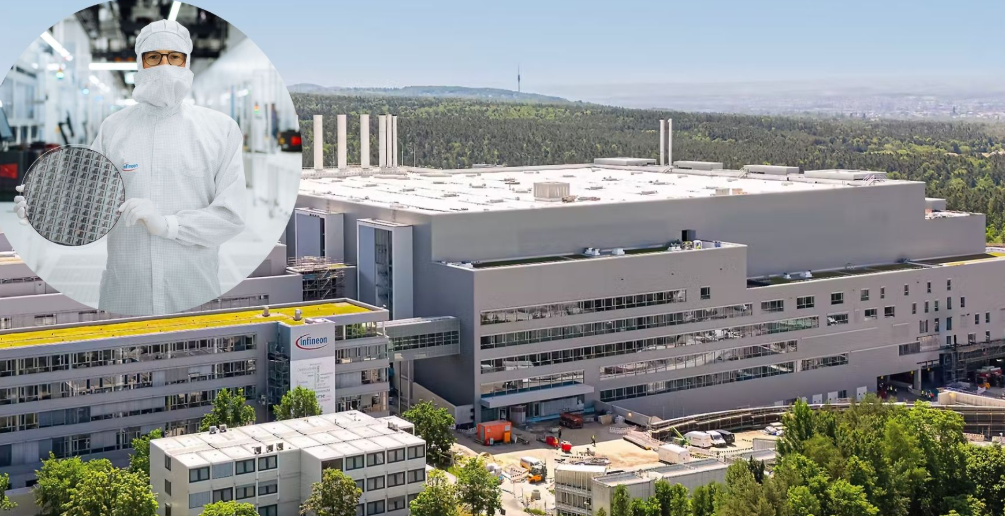
Infineon Opens World's Largest Power Semiconductor Factory in Germany
Infineon Technologies officially opened its new Smart Power Fab in Dresden on July 2, 2026, three months ahead of its original schedule. This 5 billion-euro facility represents the largest single investment in the German chipmaker's history. The company states it is now the world's largest factory dedicated to intelligent power semiconductors and analogue/mixed-signal technologies.
Construction began in May 2023. This means the plant moved from groundbreaking to full opening in slightly over three years, a pace Infineon attributes to the extensive use of digital planning tools throughout the build process.
What the Factory Actually Makes
Power semiconductors do not perform computing like GPUs or CPUs. Instead, they manage and regulate the flow of electricity. This function is becoming increasingly critical as AI infrastructure scales up. The Dresden fab will produce a variety of components, including:
- Standard power switches such as MOSFETs
- More complex analogue and mixed-signal power management chips
- System-on-chips for humanoid robotics
All these components will be manufactured on 300mm wafers.
These chips are destined for some of the most electricity-hungry sectors of the modern economy:
- AI data centres
- Battery-electric and software-defined vehicles
- Wind and solar power systems
- Industrial automation
Infineon CEO Jochen Hanebeck stated that the company is opening the plant at precisely the right moment, calling it "urgently needed capacity for the technologies that will define the years ahead."
Ahead of Schedule, and Why That Matters
The speed of delivery—three months early on a multi-year, multi-billion-euro build—was arguably as notable to industry press as the price tag itself. Infineon's Chief Operating Officer, Alexander Gorski, attributed this pace to a "One Virtual Fab" approach. This strategy mirrors processes, tools, and software across Infineon's sites in Germany, Austria, and Malaysia. It is also paired with digital twins used to plan the building and machine layout before construction even began.
Additionally, AI algorithms are being utilised to validate manufacturing systems and processes. This enables Infineon to ramp up production roughly twice as fast as in previous builds.
Backed by Public Money and Political Attention
The Smart Power Fab is partially funded under the European Chips Act and the IPCEI ME/CT programme (Important Project of Common European Interest on Microelectronics and Communication Technologies). Approximately 1 billion euros in public funding is tied to the Dresden site.
The opening ceremony attracted high-level political attendance:
- German Chancellor Friedrich Merz addressed roughly 400 attendees via video.
- Germany's Federal Minister for Digital Transformation, Karsten Wildberger, spoke in person.
- Saxony's Minister-President, Michael Kretschmer, also spoke in person.
Wildberger called the plant a milestone on Germany's path toward digital sovereignty. Kretschmer pointed to it as proof that major industrial projects can still be built securely and quickly in the region.
Jobs and Europe's Largest Chip Cluster
The fab is expected to create approximately 1,000 new, highly skilled direct jobs. This will effectively double Infineon's total manufacturing capacity at the Dresden site. The site is located within Silicon Saxony, Europe's largest microelectronics cluster, which already employs over 80,000 people across the broader semiconductor sector. At full capacity, Infineon expects the new fab alone to generate up to 5 billion euros in additional annual revenue.
Built Without Natural Gas
Sustainability was a prominent theme in Infineon's framing of the project:
- The facility operates without natural gas.
- It recycles approximately 90% of the industrial water it uses.
- It is designed to recover up to 45% of the energy consumed during production.
Infineon has set a specific target to achieve a water recycling rate of up to 45% by 2033 as the site matures.
Why This Matters for the AI Industry
The AI industry's infrastructure bottleneck is no longer solely about GPUs. Every data centre running large AI models requires power management hardware to efficiently convert, regulate, and distribute electricity. This demand is growing as rapidly as compute demand.
Infineon was recently identified by research firm Gartner as the company to beat in AI data centre power semiconductors. The Dresden expansion is a direct bet that demand for this less-visible layer of AI infrastructure will continue to climb alongside demand for the chips that perform model training.
What This Means for Businesses
For companies building or operating data centres:
- More power semiconductor manufacturing capacity in Europe means a more diversified and potentially more resilient supply chain.
- This supply chain will be less concentrated in Asia and the United States.
For automotive and renewable energy manufacturers that rely on the same component categories, the doubled Dresden capacity could help ease the supply crunches that have disrupted electronics manufacturing globally in recent years.
Conclusion
Infineon's Smart Power Fab serves as a crucial reminder that the AI buildout depends on more than just headline-grabbing chip announcements from Nvidia or AMD. Behind every AI data center lies a supply chain of power management hardware that must keep pace with compute growth. Europe has just added significant capacity to this critical chain, delivering ahead of schedule and with the backing of some of Germany's most senior political leadership.