Meta Launches AI Mode and New AI Tools for Facebook
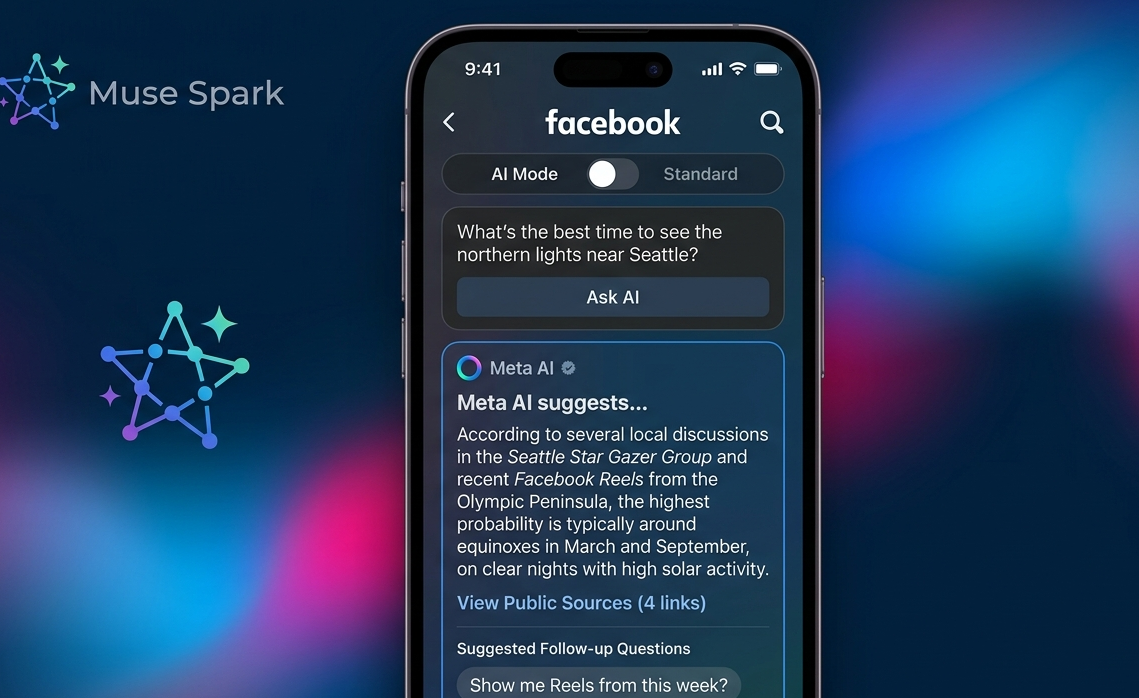
Meta announced a significant wave of AI features for Facebook on June 15, 2026. This release is headlined by a new search mode called AI Mode. Instead of returning a scrollable list of posts, pages, and profiles, AI Mode lets users type a question in plain language and receive a single, synthesized answer. This answer is pulled from public content shared across Facebook Groups, Reels, and other posts.
AI Mode rolled out globally the next day, with no separate app download required. It simply appears inside the search bar Facebook users already utilize, alongside existing options like People and Marketplace.
What AI Mode Actually Does
AI Mode is powered by Muse Spark, the first model released by Meta Superintelligence Labs, the AI division led by Chief AI Officer Alexandr Wang. Muse Spark launched in April 2026 as a proprietary, natively multimodal model. This marks a notable shift for Meta, which had previously built its public AI identity around the open-source Llama family.
Rather than crawling the open web, AI Mode draws only on public content already inside Meta's ecosystem: public posts, comments, photos, and videos across Facebook and Instagram. Meta's Chief Product Officer has explicitly stated that private messages, WhatsApp statuses, and private photos are excluded from the feature's data sources. Users can still switch back to traditional search results at any point and can ask follow-up questions within the same conversation.
This isn't Meta's only bet on this format. The company quietly launched Forum, a Reddit-style standalone app, in May 2026. Forum includes its own AI "Ask" tab that pulls answers from Facebook Group discussions.
Testing the same idea in two separate products signals how central this kind of AI-powered Q&A has become to Meta's strategy.
New Creative Tools Shipped Alongside It
AI Mode wasn't the only feature in the June 15 release. Meta also introduced a set of AI-powered creative tools:
- Collage cutout templates and video transition effects, aimed at making montage-style Reels and Stories easier to produce.
- Wear It, a photo feature that lets users virtually try on outfits, including sports jerseys. This feature is accessible through the AI Edit icon in Stories or by restyling a profile picture.
- Opt-in camera roll sharing suggestions, which surface photo and video ideas based on a user's camera roll. This feature is off by default unless enabled.
- A set of World Cup 2026 tie-ins, including:
* The jersey try-on option.
A hidden football mode triggered by double-tapping the Facebook* logo.
* A "Goal!" voice effect for direct messages.
These additions build on a string of smaller AI features Meta has shipped on Facebook over the past several months:
- Animated profile pictures in February.
- An AI tool that **auto-replies to Marketplace buyer messages** on sellers' behalf in March.
- An AI assistant for creators, offering posting-time suggestions and comment summaries, that launched just weeks before AI Mode.
Why Analysts Are Paying Attention to the Money, Not Just the Feature
The most eye-catching number attached to this launch didn't come from Meta itself. Morgan Stanley analyst Brian Nowak estimated that if even less than a third of Meta's roughly 3.5 billion daily active users ran a single AI Mode query per day, the feature could generate more than $10 billion in annual revenue.
This figure is an analyst projection based on usage assumptions, not a forecast Meta has confirmed. Still, it explains why Wall Street is treating AI Mode less as a feature experiment and more as a new advertising surface. This is similar in concept to how Google monetizes search but built on Facebook's social graph instead of the open web.
The timing aligns with Meta's broader business moves. The same week, Meta announced Threads had crossed 500 million monthly active users, and the company has been rolling out global ad-free subscription plans for Facebook, Instagram, and WhatsApp starting at $3.99 a month.
What This Means for Creators and Businesses
For creators, the practical implication is that public posting now does double duty: it drives immediate engagement and can also surface later as source material when someone asks AI Mode a related question. This gives public-facing content, especially in Groups, more long-term visibility than it may have had under the old link-based search.
For businesses, particularly sellers using Facebook Marketplace, AI Mode surfacing products directly inside conversational search answers means visibility in public listings matters more than before. Combined with the Marketplace auto-reply tool and the AI creator assistant, Meta is positioning Facebook as a platform where discovery, customer response, and content creation all run through AI by default rather than as optional add-ons.
Privacy Questions That Remain Open
AI Mode's reliance on public content revives a familiar tension. Meta updated its privacy policy in mid-2024 to allow public posts to be used for AI training, and has been doing so for roughly a year before this launch. Meta maintains that only public content, not private messages or private photos, feeds the system, and that users can opt out of having their public content used this way.
Whether that distinction fully addresses user concerns is likely to remain debated as AI-generated answers, rather than links back to sources, become the default way people search on social platforms—a shift already underway at Google and Bing as well.
Conclusion
Meta's June 2026 Facebook update is less a single feature than a statement of direction: search, content creation, and commerce on Facebook are being rebuilt around conversational AI, with Muse Spark as the engine. Whether that turns into the multi-billion-dollar ad surface analysts are projecting will depend on how many users actually adopt AI Mode as their default way of searching, and how comfortable they remain with an AI reading their public posts to get there.